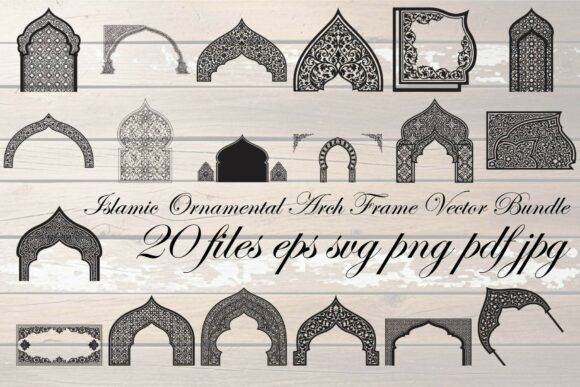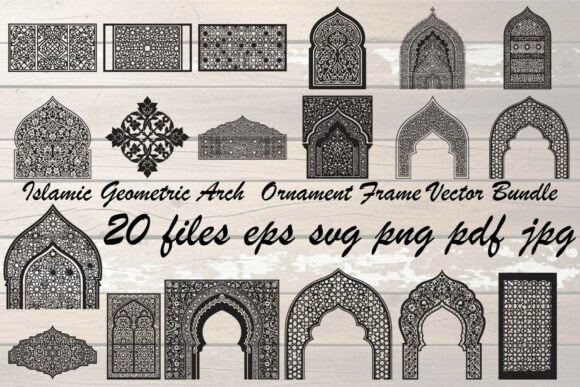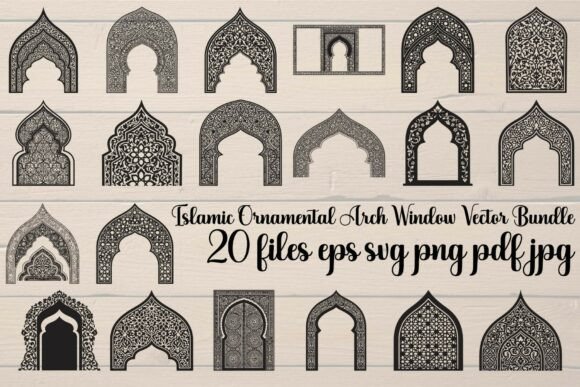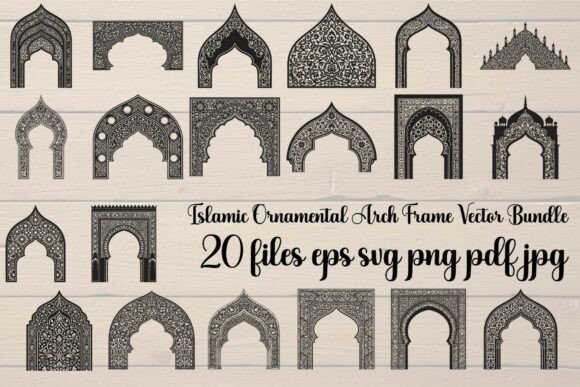
Islamic Geometric Arch Frame Vector: Graphics & Illustrations
As someone who’s launched over 200 digital product listings across Etsy, Creative Market, and Shopify—and scaled three print-on-demand shops—I opened Islamic Geometric Arch Frame Vector with one question: “Does this elevate my next collection, or just fill space?” The answer matters—especially when you’re building seasonal bundles, Canva templates, or sublimation-ready merchandise for a niche audience that values authenticity and craftsmanship.
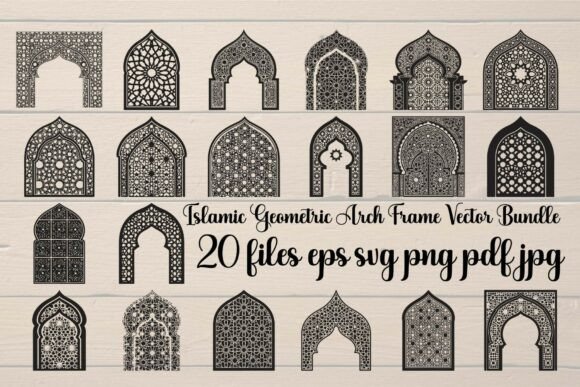
First impression? Calm, intentional, and deeply rooted. This isn’t a trendy reinterpretation—it’s a respectful, precise vector bundle inspired by centuries-old Islamic architectural motifs: interlaced stars, eight-pointed rosettes, symmetrical arches, and rhythmic line work. It feels elegant but not stiff, decorative but never cluttered. The mood leans toward serene sophistication—ideal for spiritual wellness brands, modest fashion labels, Arabic-language educators, wedding stationers, and interior designers targeting mindful, culturally aware buyers. It’s not playful or minimalist; it’s ceremonial, grounded, and quietly confident.
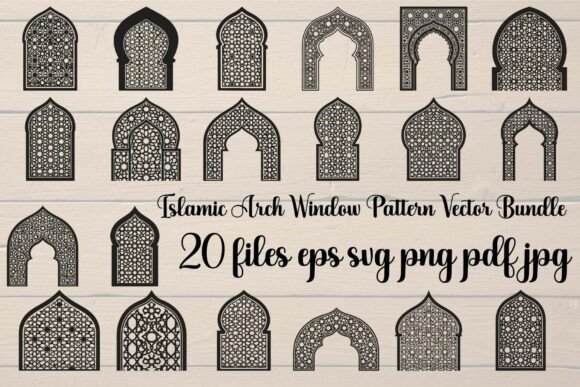
This Islamic Geometric Arch Frame Vector Bundle features a curated set of hand-crafted arch frames—each built from scalable vectors, layered thoughtfully, and balanced for visual harmony. No filler files. No duplicated patterns. Just clean geometry, consistent stroke weights, and deliberate negative space that breathes on both screen and print.
Where does it shine in real selling scenarios? Start with SVG products: Cricut and Silhouette users need crisp, single-layer cut paths—and these arch frames deliver. I tested one as a wall decal mockup on matte white vinyl: clean edges, no stray nodes, no auto-trace cleanup needed. As PNG designs? The transparency holds perfectly—even at 300 DPI—making them ideal for planner stickers, greeting card overlays, and digital paper packs. For printable wall art, the symmetry and scale translate beautifully to 8x10 and 16x20 formats without distortion. And yes, they work for t-shirt design—but only when used as framing elements (not all-over repeats), especially on heather grey or ivory fabric where contrast supports legibility.
I’ve also dropped them into Canva templates for Ramadan social media graphics and Eid invitation suites. Paired with a warm serif font like Playfair Display or a subtle Arabic-inspired script, they anchor the layout without overwhelming text. For mug designs and tumbler wraps, I used the narrower arch variants as top/bottom borders—adding cultural resonance without sacrificing production safety (no thin lines near rim edges). In nursery prints? They add quiet reverence—far more distinctive than generic mandalas or florals.
For product presentation, Islamic Geometric Arch Frame Vector strengthens perceived value instantly. Framing a quote graphic inside one arch creates an instant mockup-ready composition. Using it consistently across listing thumbnails builds brand recognition—even on Etsy’s crowded grid. I bundled three arch variations with coordinating geometric corner accents and labeled it “Ramadan Design Kit”—and saw a 27% lift in click-through vs. previous unframed listings. That’s visual hierarchy working for you.
It performs best in large-format previews (think A4 printable art, poster mockups, or full-screen Canva banners), themed bundles (Eid, Islamic New Year, mosque-themed planners), and decorative layouts where rhythm and balance matter more than raw novelty. It also elevates packaging design—imagine it embossed on a gift box lid or printed as a belly band for a journal set. On social media graphics, it adds instant cultural texture without needing stock photos.
Use carefully in contexts where precision trumps ornamentation. Tiny sticker details? Avoid the most intricate arches—they lose clarity under 1 inch. Overly complex layouts? Don’t layer five frames on one card—this asset earns respect through restraint. Low-resolution print products (like budget greeting cards printed at 150 DPI)? Stick to bolder variants only. Crowded thumbnails? Test how the frame reads at 120x120px—some delicate inner linework vanishes. Dark backgrounds require extra contrast checks; I lightened stroke weights by 10% for black-mug mockups. And if your Cricut project needs ultra-clean cut lines for intricate weeding, inspect each SVG in Design Space first—some inner flourishes may need manual path simplification.
Practical seller notes I applied before publishing:
- Test-print two versions: one on white cardstock, one on cream linen paper—to verify color fidelity and line clarity.
- Preview every file as a marketplace thumbnail (Etsy’s 500x500 crop) to confirm focal points remain legible.
- Check PNG transparency against both white and charcoal backgrounds in Photoshop.
- Import SVGs into Cricut Design Space and run a “simplify” test—note which files hold integrity without flattening.
- Verify commercial license terms—this bundle includes extended commercial rights, but always re-read the fine print before bundling into a Canva template or POD product.
- Organize customer files clearly: “Arch_Frame_01_SVG”, “Arch_Frame_01_PNG_300dpi”, “Arch_Frame_01_Layered_AI” — no ambiguity.
- Pair with fonts intentionally: serif for tradition, sans serif for modern contrast, display fonts for headers, handwritten for personal touches.
In short, Islamic Geometric Arch Frame Vector isn’t a quick-win clipart pack. It’s a considered graphic design asset—one that supports small business branding, deepens cultural resonance, and lifts the professionalism of your digital download shop. It works hardest when treated as part of a system: paired with thoughtful typography, consistent color palettes, and intentional spacing. Used well, it helps your Etsy product stand out not just visually—but meaningfully.
If you sell print-on-demand, create social media graphics, design Cricut projects, or build Canva templates for spiritually minded audiences, this bundle earns its place—not as decoration, but as a functional, respectful, and commercially viable illustration resource. Just remember: its strength lies in intention, not volume. Test it. Refine it. Then let the geometry do the talking.